
You felt that knee ache climbing a couple of stairs today — not the first time. You have been walking daily, you may think it is fine and the ache will disappear with time. But, will it?
You are doing the right thing by staying active. Now let’s make that effort work harder because the real question is how to keep joints healthy as you age. Although there are many ways to do this, as a physiotherapist, I recommend focussing on these 3 foundational pillars:
- Use weights to keep joints healthy
- Maintain a healthy body weight to reduce stress at the joints
- Eat well to support joint health
Use weights to keep joints healthy
Walking for an hour daily is great, it helps to keep your heart healthy and strong. But you also need strong muscles to support the joints as you begin to age. You can think of your muscles as a cushion around your joints. The stronger they are, the less pressure your joints take with every step. And one of the best ways to build that cushion? Strength training.
Simple home exercises with light weights, done consistently, are one of the most effective ways to maintain healthy joints as you age. Research shows that people who did regular strength training had about 20% lower rates of knee osteoarthritis and knee pain. Even those who begin exercising later in life appear to benefit1.
A lesson from my mum
My 65-year-old Indian mum had been struggling with knee pain for years. Stairs had become her biggest challenge of the day. Instead of joining a gym, we decided to start with some exercises at home.
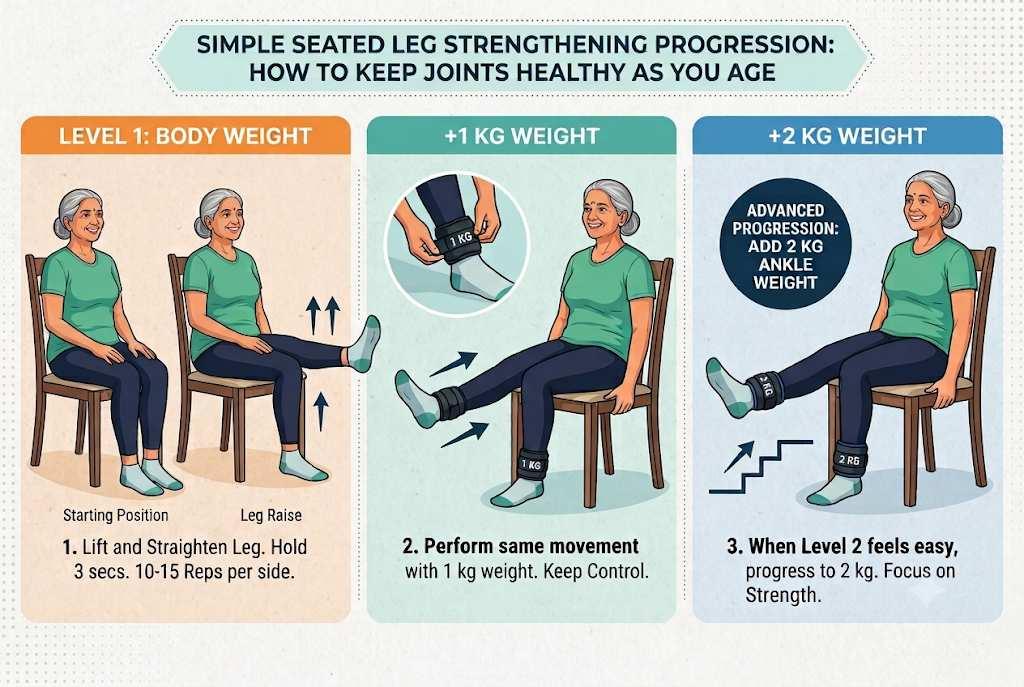
We started with knee movements while sitting on a chair using only her body weight, focussing on proper movement and control. Once she could comfortably perform the movements, I tied a 1 kg weight at her ankle and asked her to perform the same knee movements. Initially, it was tough. But with consistent, daily effort she was able to do them perfectly. After a few days, she felt that the movements with 1 kg weight were easy. That was the time we decided to progress to the 2 kg weight and a different set of movements.
Within a couple of weeks, she began noticing that climbing stairs had become easier and far less painful. Today, she walks up and down the same stairs with minimal discomfort.
I can still hear the joy in her voice when she first told me how much easier it had become.
Her experience is a reminder that it is never too late to strengthen the muscles that protect your joints.
And the benefits go beyond the joints. In a large study of young, middle-aged and older adults, people who were more physically active experienced higher life satisfaction and happiness, and overall, these feelings tended to increase with age2.
This is something mum would wholeheartedly agree with.
If you are not sure where to begin, start with this:
Sit comfortably in a chair and slowly straighten one leg, hold for 3 to 5 seconds, lower slowly. Repeat 10 to 15 times.
Once this becomes comfortable, tie a 1 kg weight at the ankle and perform the same movement. As it starts to feel easier, progress to a 2 kg weight (and so on), just like my mum did!
Maintain a healthy body weight to reduce stress at the joints
Every extra kilogram of body weight you carry puts additional pressure on your joints, particularly your knees and hips. It is similar to carrying a heavy backpack — the heavier it is, the more your legs feel it. Research has found that extra body weight can wear your knee joints out faster over time3.
Instead of trying to achieve a number on a scale, it is more about understanding that maintaining a healthy body weight is one of the most powerful and sustainable ways to protect your joints as you age.
Body weight was never an issue for my mum. Even with the strength training, she kept moving, and eating the way she always has: home-cooked, balanced, and mindful. That quiet combination worked well for her.
Eat well to support joint health
Think of your daily meals as a way of supporting the maintenance of healthy joints as you age.
The Indian National Institute of Nutrition’s dietary guidelines, as highlighted in the research by Tattari and colleagues in 2022, recommend that older adults should include plenty of protein, fibre, vitamins, minerals and fluids while limiting excess salt and processed foods4. Our Indian kitchens are beautifully equipped for this.
Some examples include:
- Leafy greens such as spinach and methi
- Vegetables such as carrots and tomatoes
- Citrus fruits such as amla, lemon, and oranges
- Protein-rich foods such as dal, rajma, chana, paneer, eggs, and fish
- Whole grains such as ragi and jowar
- Water, buttermilk, and light soups
- Soft, well-cooked meals that are easy to chew and digest, such as khichdi, soft idli, or well-cooked sabzi, with less salt and moderate spices
So, those stairs? They do not have to stay a struggle.
Start small. Pick one exercise, keep moving, and make one change to your diet this week. Observe the difference.
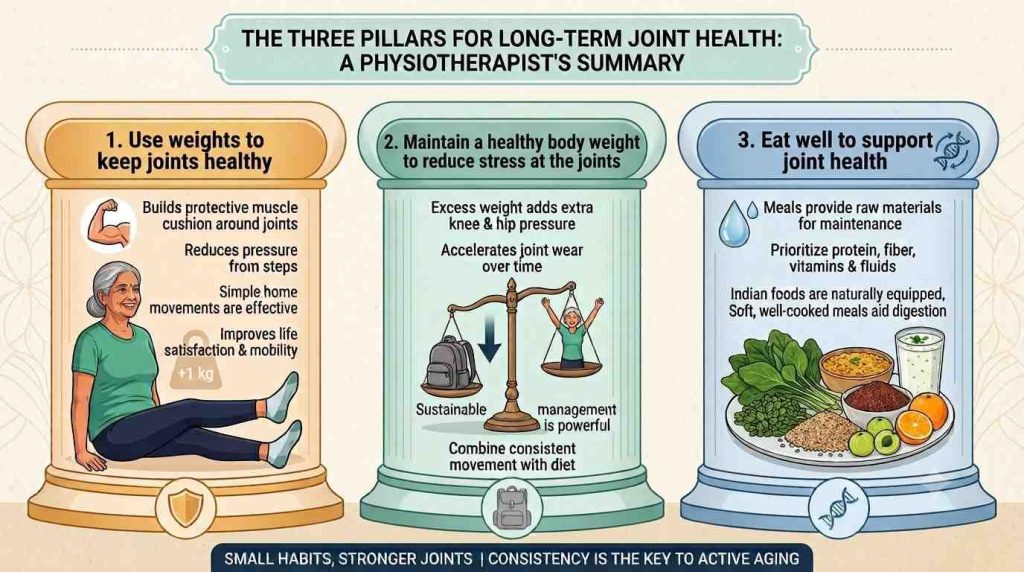
Learning how to keep joints healthy as you age is all about small, consistent habits!
If you have a joint health tip that worked for you or someone you love, please share it with us. Your experience could be someone else’s turning point.
Know when to see a doctor
If your joint pain is severe, associated with swelling, redness, fever, or has started after an injury, consult a healthcare professional before starting a new exercise program.
References
1. Lo GH, Richard MJ, McAlindon TE, et al. Strength training is associated with less knee osteoarthritis: data from the osteoarthritis initiative. Arthritis Rheumatol. 2024 Mar;76(3):377-383. doi:10.1002/art.42732.
2. An HY, Chen W, Wang CW, et al. The relationships between physical activity and life satisfaction and happiness among young, middle-aged, and older adults. Int J Environ Res Public Health. 2020 Jul 4;17(13):4817. doi: 10.3390/ijerph17134817.
3. Adouni M, Aydelik H, Faisal TR, Hajji R. The effect of body weight on the knee joint biomechanics based on subject-specific finite element-musculoskeletal approach. Sci Rep. 2024 Jun 14;14(1):13777. doi:10.1038/s41598-024-63745-x.
4. Tattari S, Gavaravarapu SM, Pullakhandam R, et al. Nutritional requirements for the elderly in India: A status paper. Indian J Med Res. 2022 Sep;156(3):411-420. doi:10.4103/ijmr.ijmr_2784_21.